Saturday, August 18, 2018

Film contests, time, & deadlines

Last month was the annual 48 Hour Film Project for Pittsburgh. I've participated in several of those contests in the past, even taking on the role of team leader. Unfortunately, for this contest, I had to step away. I've probably touched on this before, but it's great experience that really tests your talents as a creative. It's also one of the most draining experiences I've ever been a part of, which is why I elected to sit out this one, in any capacity.

While it is fantastic to work towards that goal of creating a film under time constraints and work with my friends in colleagues around Pittsburgh, I've become a little hesitant towards working long hours on set to reach that goal. Not that it happens every time. And sometimes it has to be done to get the job done. I understand that. It has just been very taxing in the past, so I needed to step away from any offers to participate this time around.

I'll be back in the game next time around. Maybe even in a leadership role, like I swore I'd do again. In the meantime, I never got a chance to share the film projects I worked on late last year. I had some photos I wanted to share from both shoots, which I finally uploaded to my website. I've been moving everything off of Flickr and migrating onto my own website in order consolidate on creative content locations. Check them out if you get the chance. It's always fun to capture the magic that happens on set.

For a little background on the photos, I had the opportunity to participate in the horror-themed 48 Hour Film Project, something that I've become familiar with over that last couple of years. As I just mentioned, I have led a couple of teams in the past, but my ever shifting and busy schedule has led me to take a back seat on the more recent projects.

It's nice to take a less prominent role on set, after working as a Director of Photography over a majority of last year (on the set of Body Farm). I've been asked to work as a gaffer or grip on various other occasions, but my day job always had to take priority over the course of this year. Thankfully, a few contests cropped up that allowed me to help with some filming on the weekends.

As I've mentioned previously in my blog, the 48 Hour Film Project is something that I've become very familiar with over the past few years. As a team leader for both Suture Films and Cipher Eye Media, I was able to work with a great group of talented individuals in all aspects of the filmmaking process. Of course that also included all of the costs and frustrations that came with being involved with the whole process, including the lack of sleep and unexpected hiccups in the process (camera overheating issues, editing software crashing, etc), which I experienced a lot of during my team in charge of teams.

After my third outing as team leader, I decided to help out on an 'as needed' basis, as my crewmates became busier with their lives and I battled some personal demons. As I also mentioned before, I eventually had to take a break from the film scene in Pittsburgh to get some things in order.

2017 proved to be an improvement over the disastrous 2016 that I endured. Anyway, not to get too personal, but I eventually became eager to return to that film grind that I loved and missed so much.

So, when the projects rolled in for 2017, I jumped at the opportunity to be a part of them. Pittsburgh's 48HFP also hosts a horror-themed contest in the fall (closer to Halloween). The guys at Reckless Amnesiac (of Hobo Hunters fame) put together a team to participate in the event.

I was invited on by the team to assist with audio recording and any other duties that required extra hands on set. As always, it was a pleasure to work with these guys.

Since I had only operated sound gear a handful of times in the past, this was a bit change to operate a boom and recorder on this production. Sound had never really my thing, but I had always understood the importance of getting good sound on a shoot (something that could be overlooked newer filmmakers).

With the change on responsibilities on set, there always comes the process of thinking of how to efficiently do those responsibilities to the best of your ability. I had the think outside of the box, as this was a different department than what I was used to. How do I get close enough to the actors in wide shots? How do I keep up with actors while they are moving, while also avoiding the frame while the camera is moving with the actors? These were questions that I constantly had to ask myself.

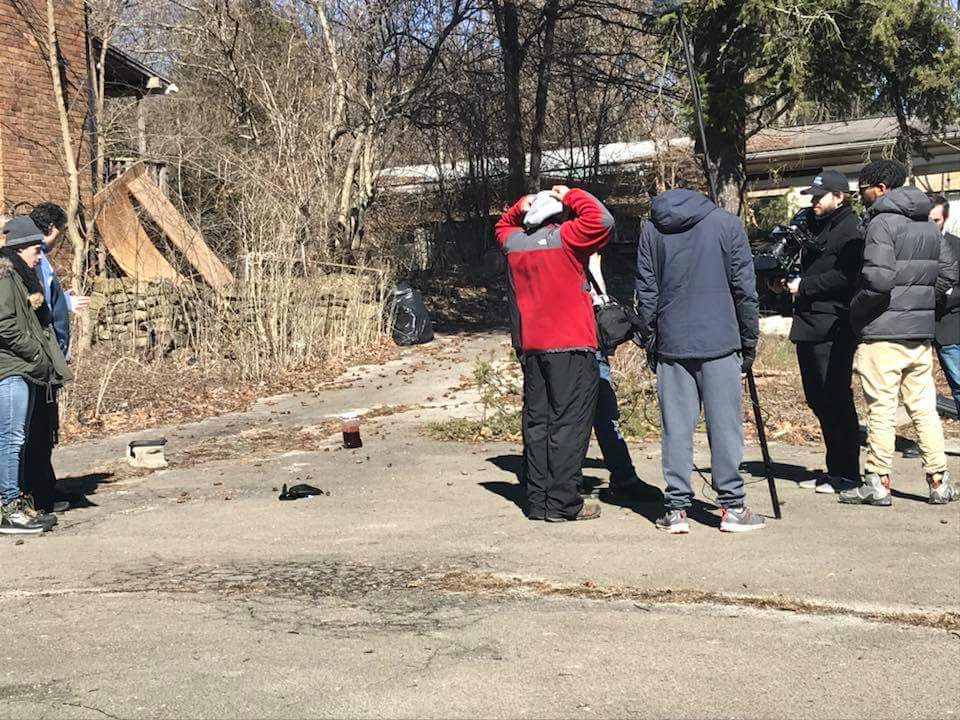
The Reckless Amnesiac crew is also good at finding very unique and appropriate locations to shoot at. This was no exception. They had tracked down an abandoned house with old, creepy objects that were left behind: the perfect location for a horror shoot.

As a side note, the South Side Slopes (our shooting location) have many, many steps. It feels like they go on forever when you're carrying around production equipment. I still get horror flashblacks.

Anyway, the inside of this house was every bit of weird, gross, and intriguing, making it one of the more interesting shoots that I've been on. The dedication, professionalism, and good nature of the crew also made this a very fun shoot to be on, even after we had wrapped in the late hours of the night.

The final product is a film called Infective, which is available on YouTube.

Moving on from that, I was invited to assist with a different crew a month later. This time, I was back in the camera department, assisting with any lighting setups and camera needs. This shoot was very unique, as it allowed us to explore facilities available at Point Park University and Pitt and utilize them as shooting locations.

The contest, the Four Points Film Project, follows the same basic idea as the 48HFP. The result was an awesome little film called Low Probability.

 I enjoyed assisting in this film because I had the opportunity to work with individuals that I had never met before, providing a different approach to the filmmaking process and showing me different techniques.

It was a great new experience, complete with unique locations and some real insight to the screenwriting process. Once again, it was a late wrap, but I was very happy with how the film turned out and hope to work with this group of creatives in the future.

Speaking of screenwriting, I've decided focus more on writing going forward. While I won't be completely leaving the filmmaking scene, my focus on writing will take up more of my time, meaning less film/video/content production (for the time being). I will be updating frequently on how that process is going and what I've learned in the process.

In the meantime, I hope you are all still feeding your creative needs. Feel free to contact me for any assistance in the future.

Cheers!
Steven

Sunday, June 17, 2018

The Inspired Traveler

Though I've not traveled much in the past couple of years, it has always been in the back of my mind. When can I get away and how can I afford the luxury only select few can afford?

Well, it also hit me that time is very limited and traveling is often used to inspire artists and creatives. I, for one, have been looking for something to kick-start the creative writing that I've been holding off for far too long.

My personal belief is that travel can help to move along the constipated condition that is known as writer's block. Travel can also be used as a motivator, helping you to find the right creative state of mind.

Sometimes it's important for me to remember my priorities when I have so many things going on in my life. Stepping away from the chaos of everyday life helps to re-prioritize your daily tasks and find the time to let your creative energies flow.


In my ever growing struggle to maintain a personal life, juggle several hobbies, produce content, work a 9-to-5 job, and freelance in both video production and writing, several things tend to get lost in the shuffle and priorities constantly shift on a daily basis.

For example, my podcast has a total of nine episodes recorded, only six of which are currently out. Two were recorded back in January, but due to the constant barrage in my ever shifting routine, I had to bench a couple projects while I got a few other things sorted out.

Life as usual.

Anyway, to escape from the constant grind of things, I was able to make a trip to the city of Minneapolis. Originally planned as a trip to see one of my favorite bands play (Closure in Moscow),  we mapped out some fun adventures as we scoped out the city.

This had been the first time that I had gotten away in about three years. In that time, I had forgotten the true importance of getting away.

Certain college and university institutes actually provide the opportunity to study something called Travel Writing. Particularly, Chatham University comes to mind.

When I was applying for graduate programs about six years ago (christ, I'm getting old), I looked into the particular Fiction Writing program that was available through Chatham. It was interesting because it placed an emphasis of moving around to faraway locations and using that experience to help get the juices flowing.

As writers/creators, we are constantly pulling from our real-world experiences to create a world beyond our own. Travelling certainly has its perks, as it gets you away from the daily repetitive grind to show you something new and exciting. We can ultimately expand on ideas with this fresh take on the world around us.

Even just having a "staycation" can help with clearing a cluttered mind, filled with the fragments of our "important business" that we take priority over. How doI benefit from stressing over our short-term accomplishments in our 9-to-5 grind? It comes down to just wasted time and money that has to be thrown away to the rising costs of living.

Of course, we're all wired differently, so maybe my needs are much different from yours. Some people do very well with the time that is given to them, and I always admire that. Unfortunately, I can get drained by the barrage of repetitive work, which is why I find such love for an "escape" every now and then.

If you find yourself in a tough spot creatively, just remember that it's important to step away from the routines of life and explore something new, helping to provide something fresh to bring to the table.

To see more from my trip to Minneapolis, please check out my newly updated photo section on my website (Sorry it's not more organized. It's still a work in progress).

Until next time.

Cheers.
Steven

Monday, March 12, 2018

Behind the camera with Reckless Amnesiac

After discussing the next big project by Reckless Amnesiac, I was offered to assist with the first two episodes of the hilarious series known as Hobo Hunters. It was a fantastic experience and I'm always honored to work with the legendary Ian Altenbaugh and Joe Bucci.

SHAMELESS PLUG: For more on the series and the creators, check out the second episode of the Decipher the Media Podcast
Photo credit: Rebekah Lehman

So, I figured it would be a good opportunity to talk about it in my blog. How did it feel to get back behind the camera after wrapping the long-in-development Body Farm? Obviously, great. To work on a comedy series that spoke to my dark sense of humor...well, that's what made this so wonderful.

We shot two episodes in one weekend. Each episode only took up a day of production (about 10 hours). Working with these gentlemen before, I know what to expect. The level of knowledge and professional demeanor of these guys was directly reflected in the quality of the production.

I was lucky enough to be one of the two on camera in a two-camera setup. It gives me a bit of envy when I work with a camera like the Blackmagic. My personal setup throughout Body Farm was a Canon EOS 6D with an L-series zoom lens, so I've always wished for something more. Unfortunately, Blackmagics were always a bit out of my price range, so it's always great to work with one on a production.

Photo credit: Rebekah Lehman

The only difficulty I experienced with this production was the physically demanding aspect of a documentary-style production. Carrying around a rig all day took a lot out of me. My shoulders and arms were extremely sore by the end of the weekend, which is probably a direct reflect of how out-of-shape I am. I guess that's more reason than ever to get back to the gym.

I'm hopeful to have a camera setup like this in the near future. In the meantime, I'm just happy that my background in camera operations still finds a use in the local community of filmmakers.
Photo credit: Rebekah Lehman


The strongest aspect of Hobo Hunters, by far, is the writing. Ian and Joe clearly know how to write something that is both hilarious and socially relevant. Sure, the comedy might not be for everyone, as it pokes fun at topics like religion and cultural stereotypes, but it does so in a way that is relevant to today's bubbling climate. It teaches you that you shouldn't take life too seriously.

It especially speaks volumes to me.Maybe this wasn't the creators' intention, but we, the audience always draw our own interpretation of an artist's work. In this case, that was my interpretation.

Maybe this will finally be the fuel I need to hop back into the world of writing after such a long hiatus. Time, always being my enemy, will tell.

In meantime, I am grateful for being involved in another project from these fine gentlemen. We'll certainly cross paths again soon.

Cheers,
Steven

Photo credit: Rebekah Lehman

Thursday, February 15, 2018

Soap Box: Relationships as professionals and effects on the job

Moving into 2018, I wanted to look back and touch upon some tidbits of knowledge that picked up along the way. It has been a great journey so far and I'm very appreciative of everyone that has come into my life. I have made some strong bonds that I am very proud of. As creatives, it's all about understanding and reaching that common goal that makes it all worthwhile.

We are as strong as our weakest link. I'm sure that's been quoted many times before by many different people. Personally, I heard it a lot when I play sports in high school. Of course, I was never really good at sports, so maybe that quote was directed at me in that respect.

Anyway, the quote reverberates to many aspects of our lives. I think of this quote as I'm writing this because I think back to the many creative productions I've been on and how they've panned out based on every individual's strengths and weaknesses.

I feel my biggest fear is letting down my teammates, no matter what the job may be or how closely I'm involved. Specifically, my roles in film projects come to mind.

There have been times that I have worked myself to exhaustion with moonlighting then came to a film set and felt useless as I struggled from the lack of sleep or energy. So, why did I continue to do this? Because I felt every project was worth it. I felt my crewmates were counting on me to get the job done. Most importantly, I understood that I was a piece of a puzzle.

A puzzle? What good is a puzzle with a missing piece? They each play a part to create something that is much bigger than themselves. And when finished, the results are beautiful and create a larger understanding of the roles of each interlocking piece.

At the point of this photo, I had gone at least
36 hours without sleep.
We, as a crew, interlock to create cohesive matter. At the time, we might not be able to see that. It's not until we witness the finished product that we understand.

In a film production, it can sometimes be hard to see when it matters to work together as a well-oiled machine. I know there are times that my flaws can get in the way of seeing the bigger picture. Nobody is perfect, and it is our duty as human beings to work around our imperfections to achieve a greater goal.

Each position and department on a film set has their own specific set of duties. However, they should never work against each other. It is our job as a crew to create an understanding of the overall goal and how to achieve it. We operate to obtain the same thing.

As I mentioned before, that can be overshadowed by our personal demons. I know there are times that I can be selfish, which can go against the common goal.

As a Director of Photography, I may have a different vision that the Director. Understanding the importance of understanding each other is something I always try to keep in mind. Everyone works differently. It is our job to use our own strengths to build upon our crewmate's strengths.

It feels good when it all comes together. As you all have heard, Body Farm is complete and had a
very successful premiere. I'm very proud of everyone involved and I feel that we all shared a very special bond over the past few years.

I know I can be difficult at certain times because my stubbornness and pride get in the way. For those of you out there who were patient with me, I am forever grateful.

I also know that I'm not the most technically educated in the terms proper set etiquette or techniques. I did not have the opportunity go to a proper film school. In fact, I did not know where I wanted to go with my life until my junior year of undergrad. And I have Juniata College to thank for helping me along the way, even though I only scratched the surface by the time I graduated.

However, I feel that it is important to continue to learn even after our educations have finished. Even without a proper education in professional filmmaking, you will still find me assisting in any capacity on set, making mental notes of how others do their jobs and being observant of how everyone works together. I will then do my best to fill in where needed.

Large egos can sometimes get things done in a production. Conversely, large egos can also create a very toxic environment on set, if one individual places themselves above all else. It is important that we all remain humble and understanding of each others needs in a film production.

Why am I speaking of the importance of teamwork? Because I don't want anyone reading this to make the same mistakes that I have made. I've made a lot of connections over the past few years. But I've also burned some bridges, not realizing until it's too late.

It's inevitable in this industry that we can't always please everyone, but it is important to understand their perspective to help complete a common goal.

I'm very thankful to everyone that I have ever worked with. No matter the size of the project, I appreciate the efforts that are always put forth. You guys are what keep me going.

Wrapping up the last few projects, I wanted to share this clarity and insight with you. As artists, we are a community of like-minded individuals.

We are a family. And I'm so proud of my family. I'm looking forward to growing with you in 2018 and beyond.

Much love, my friends.

Cheers,
Steven

Monday, October 30, 2017

The art of game capture: my 'Let's Play', four years in the making

Since I discovered this form of media existed, I have slowly cultivated the idea to produce something to call my own.

I believe it was around 2013 that I stumbled upon the world of Let's Plays. Although they've likely been around since the availability of capture technology, it really seemed like 2013 was the year that it was becoming mainstream. It was the first time that it garnered my interest.

Sure, YouTube celebrities like PewDiePie and Markiplier were at the forefront of the Let's Play movement, but it was a growing company known as Achievement Hunter that introduced me to Let's Play.

I remember stumbling upon my first Let's Play video. Two men were operating the stiff hands of a ridiculous game called Surgeon Simulator while commentating on their flubs as they attempted do heart surgery. It was absolutely hilarious. Since then, I've been following the Achievement Hunter troupe and taking notes on the technology that they use to create these wonderful videos.
The first iteration of my video game project.
Now, I have no intention of ever making a career out of this. I simply wanted to do this because it combined many aspects of my passions in digital media. Video games? Check. Recording? Yeah. Video editing? Yup. The creative development process behind producing a video? Many of the elements are there. From that point on, I was sold on the idea of creating my own Let's Play channel.

But then life happened. In 2014 and 2015, I was moving around a lot in a whirlwind of work and living. I was also more heavily involved in the filmmaking community, meaning that I had to put this project on the back burner. I hate when I'm forced to do that, but there is only so much time in the day.

Around late 2014, I recorded my first Let's Play test run with my now ex-girlfriend. We played together in a world that we created in Minecraft. It was my first taste on how difficult this process could be. Tensions were high as technology was failing. It was definitely not a success. So, I decided to, once again, put the project on the back burner.

Then more moving happened and more fell on my lap, consuming all my spare time. It was 2016 and I was living in a tiny apartment in Pittsburgh. My budget was tighter than usual, but my passions remained the same. My friend came to me with the idea to start a podcast, being one that never shies away from new opportunity, I agreed to work on back-end of the podcast, handling the hardware and software that would record, edit, and release episodes of the podcast.

I found that my aspects of the process could be incorporated into recording for a Let's Play. Once ,
again, I felt the urge to make a Let's Play. This time, I used the knowledge I had gained from recording a podcast.

I started with something simple. I tried capturing a mobile game off of my phone using software that was already built into into my PC. It's a very simple setup for capturing. At that time, the Miitomo app by Nintendo had just released. This hybrid game/social app was perfect for my experiment. I event tried adding a facecam (webcam recording me while I capture my audio and the screen). The results were satisfying.

Unfortunately, I had to shelve my second attempt before I even got around to editing it. This time, it was for more personal reasons. Life really has a way of throwing some curveballs.
The most recent iteration of my gaming project.
Halfway through 2017, life was finally settling down. Again, I wanted to scratch that itch of recording a Let's Play. On a late Saturday evening, I sat down at my desk and booted up the game 20XX on my PC. Without any script or guidelines, I recorded a playthrough.

I was highly satisfied with the results, though pretty amateurish by nature. My next step was to work on the back end and prepare all of the resources necessary to edit and publish my video. After a lengthy process of trial-and-error, software testing, and workflow testing, I was satisfied with my results.

Here is the final product:


Thanks so much for taking the time to read this and thanks again if you gave the video a watch. There's still a lot to improve on. My philosophy has always been that everything has room for improvement. Feel free to pass along any of your own input. I love constructive criticism.

Until the next time.

Cheers!
Steven

Friday, October 20, 2017

Adobe Premiere Pro: A few efficiency tips, assembling your clips

Today, I'm doing something a little different. I'm creating a guide that is not only something I wanted to share with you, but also as something that I can reference myself.

Recently, I've been jumping back into editing. Although it is something that I love doing, post-production is also something that I can go months without doing. However, with the new wave of projects I'm working on, I'm finally able to jump back into editing software, such as Adobe Premiere Pro and Adobe After Effects.

I've been an Adobe user since I began working with their software back in college. When I began photography as a hobby, I started with the basics in Photoshop and Illustrator. Through that, I was introduced to many of their related programs.

From a video editing perspective, I was "classically trained" in Final Cut Pro. This was when the software was a fantastic and powerful editing too. Not the stripped down Final Cut Pro X that was released a few years later.

However, when I was working from my dorm, I had no access to Final Cut. My solution was to test out the alternatives. I found Adobe Premiere Pro to be a very effective editing tool for the jobs that I needed done.

After graduation, Premiere Pro became my primary tool for video editing. It wasn't until I started diving deeper into local video projects that I was able to heavily utilize this tool. Unfortunately, there came a time that I had to step away from post-production.

Which brings me to my point. When I haven't used certain software in a while, I tend to just forget all of the shortcuts and tricks that make my job a little easier. I've decided to go back and refresh myself on some of the basic shortcuts, not only for me but also for any new or amnesic users.

Let's start with the basics. I'm sure I'll touch base on some more advanced techniques in the future. For now, let's look at the simplest commands and organizational methods associated with assembling video clips in Premiere Pro.

Storyboard those clips:

For any project that requires organizing a variety of clips into a coherent story (through the power of editing), it might be beneficial to separate those clips into a storyboard WITHIN Premiere Pro.

How? Basically, if you look on the bottom left of your screen, you'll see all the clips for your session. There is also the option to create Bins (Folders) for your clips in order to better organize them.

Editing clips in the Source Monitor

In terms of organization and pre-Timeline actions, I just wanted to provide a quick rundown on some of the commands available for editing in the Source Monitor. These are the ones that I discovered to help with my efficiency.

Key
Command Name
Description
I
Mark In/Set In Point
Mark the beginning of your clip selection in source
O
Mark Out/Set Out Point
Mark the end of your clip selection in source
Shift +I
Go to In
Move to In marker in source
Shift+O
Go to Out
Move to Out marker in source
.
Overlay Selection
Replaces current position on Timeline with Source Monitor selection
,
Insert Selection
Inserts Source Monitor selection into the current place in the Timeline

With these tools, you can make selections from the Source Monitor. These selections can help to trim down a particular clip without any editing in the Timeline.


These buttons associated with the shortcuts are available right below the Source Monitor.


Once you have your selection, you have your Insert and Overlay tools to place your selection into the Timeline.


Assembly for screen real estate!

And in case you couldn't tell from the previous screenshot, there are various ways to assemble your workspace. If you happen to be working on a small display and can't quite cram the Source Monitor in with the Program Monitor, there is also a very nifty Assembly tab at the top, which will toggle the layout to only display the Assembly monitor, freeing up some space for any preliminary clip management and trimming before jumping into the Timeline.


So, those are just a few items I learned with clip and time management in Adobe Premiere Pro. Of course, some of these could also apply to any nonlinear editing tools, so hopefully this information can be a learning experience for all just jumping into editing or needing some productivity tips.

As I learn (or relearn) more, I'm hoping to return with some more items in the future. Thanks you for stopping by!

Until next time!

Cheers!
Steven

Saturday, September 30, 2017

Putting the "royalty" in "Royalty-Free"

For us content creators out there, we've been in the situation where there are certain aspects of the creation process that we cannot completely control. We want our vision to come as close as how we see it in our heads, but sometimes the resources or funding aren't always there.

Yes, this is a stock image. Yes, people actually do use these stock
materials for projects (I think).
This is where 'stock' websites come into play. There are resources available for creatives seeking to incorporate something like an image into their project. These websites provide a catalog of media that a user can download. It could be a stock photo, music, sound bit, video, graphic art...the list goes on.

It is always important to note that there are rules and regulations to using stock content. Before, we get into the subject of "royalty-free", let's discuss the "pay" method of acquiring stock content.

When I started my first podcast, Theater N'At, a couple years ago, I needed some music that could break up the introduction (what was called a "cold open") and the rest of the content of each episode of the podcast. I was lucky enough that I had previously purchased some music that was used in a short film prior to the podcast.

Since I had purchased the license to the music, I was free to use that music as our opener and closer for the podcast, without the need to provide any information on where I had acquired the music.

If my memory serves me correctly, this music was downloaded with the purchase of a Standard License, which covers all the basics of use. I believe the price of use was around $50, but once again, you're getting unlimited use out of this music track.

Most stock websites are very explicit about what they want done with their resources and how they want credit to go towards said resource. Is your project for commercial or personal use? That's also factored in.

Now we come to the term you might find on some stock websites: "royalty-free". Instead of paying for a license, sometimes the creator simply requires you to credit their work somewhere in your project. If the stock content is a video clip that is included in your own video project, you may be expected to include information about that clip in the credits at the end of your video project.

It all depends on what the stock provider expects from their user. If you're searching for something specific to add to content that you are creating and editing, don't always go with the first result that pops up in the Google results. Sometimes it's better to take the time and do your research.

Which brings me to my next big project. My next podcast, Decipher the Media, was also in need of some music to serve as an introduction. Instead of using that previous track that I've purchased and continually recycle, I decided to find some new music that would fit well with the podcast.

First, I went to the Google machine. The top results were all "sponsored", but I decided to leaf through them to see what they offered. Like the music I already had, most of them required a Standard License purchase for about $50. I wanted to work around having the pay that price for my startup podcast, but I also didn't want to give required credit in my work for something "royalty-free". So, I dug a little deeper.

I found a website called freestockmusic.com. As generically questionable as it may sound, it actually provides some decent tracks with very few restrictions for usage.

Basically, here's how this website operates, based on the FAQ:

"You sign up for the site and we give you free music. If you still aren’t buying it, you can read the testimonials of our users who will happily agree there is no catch at all."

"We are sponsored by a stock footage company called Footage Firm. Because of this sponsorship, we don’t worry about making money — we only worry about delivering the best resource possible for free production music. In exchange, Footage Firm gets some good PR and marketing."

"Our music comes with a royalty-free, worldwide license agreement that never expires...You are permitted by our license agreement to use our music commercially as long as you add substantial value to the songs."

"The term “substantial value” means you modify or add to the music in a way that makes it uniquely yours. Simply by adding it to a video or singing lyrics on the song, you add substantial value to it."


Digging even deeper, I wanted to make sure there wasn't a catch. I also needed an elaboration on the music usage, since there was no current mention of usage in audio media, such as podcasts.

Here's what I found in the more detailed user agreement:

"For any Stock Files you obtain from us, you may incorporate them into any project, commercial or otherwise, including feature films, broadcast, educational, print, multimedia, games, merchandise, and the internet. Once you incorporate a Stock File into your project, you can share your finished project freely, but you may not share the underlying individual Stock File as a standalone file with anyone else. (That said, you can share individual Stock Files with your client or someone else for the limited purpose of getting their help with your specific project, assuming you are adding substantial value to the project apart from inserting the Stock Files. Otherwise, they need their own license.) You also agree to use your best efforts to avoid letting the Stock File be accessible to others as a standalone file, but since that’s not always possible, your inability to prevent copying will not be considered a breach of this License." 

To my understanding, as long as I'm not just sharing the unaltered music file, I am free to use it in any sort of media project. This includes commercial use. That's a pretty good deal.

As implied, it's important to read these agreements because every royalty-free website is going to have different rules and regulations for using their content. You don't want to get caught in any sort of legal situation just because you didn't read the fine print. So, always do your research.

The particular track I used is now the current opening and closing tune for my podcast. I'm sure that I'll try to switch it up in the future, since these tracks can still be particularly generic and may not be the closest thing thematically.

This is a particularly interesting topic that I'm sure I'll touch on in the future, hopefully in a different format, such as stock video or images.

Until next time.

Cheers!
Steven
This is actually part of a whole series of stock photos. Seriously. Look it up.
\